
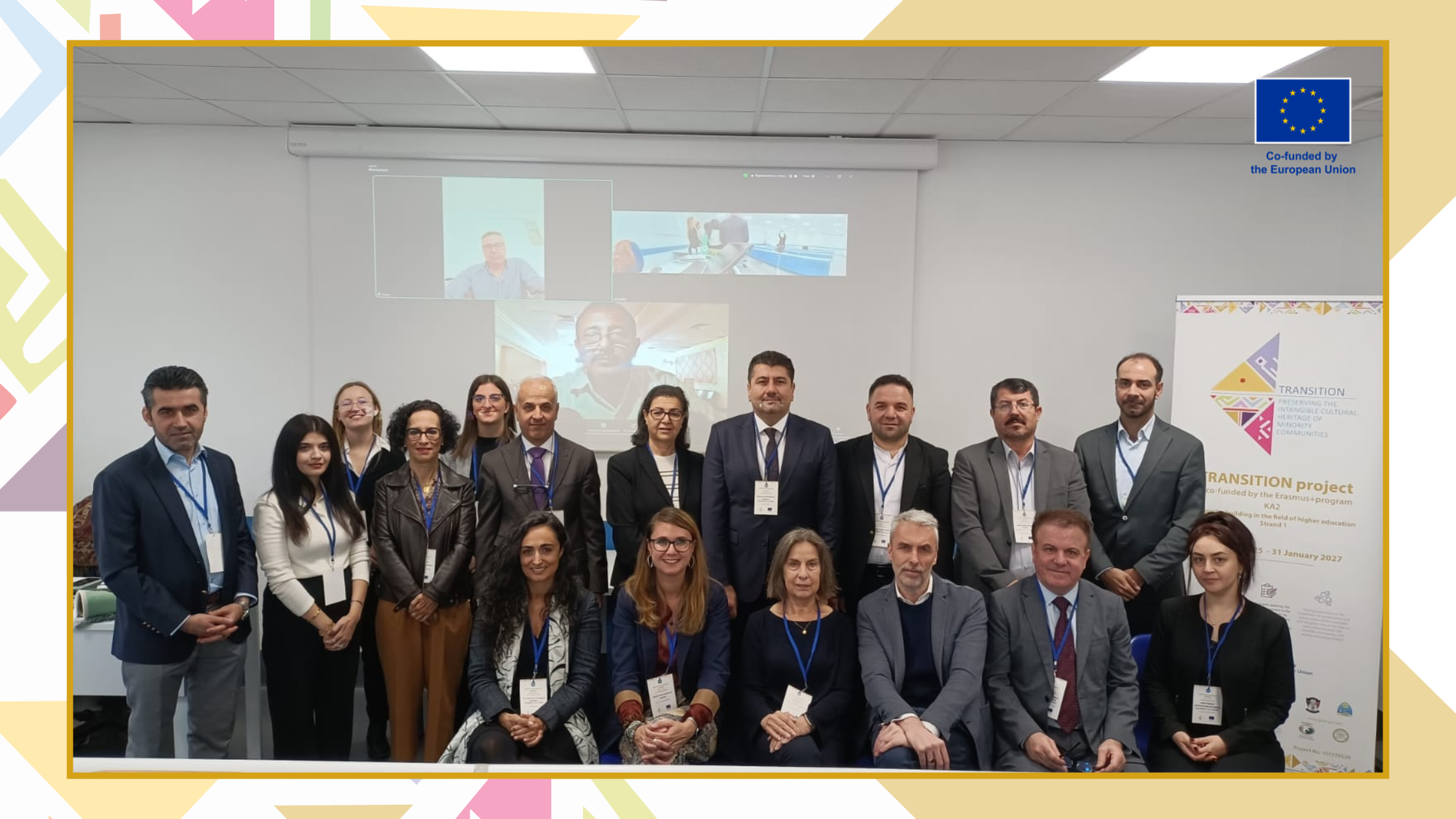
On 20–21 October, the first Mid-Term Management Meeting of the Erasmus+ TRANSITION project was held at the International University of Rome (UNINT), hosted by UNIMED.
The two-day event gathered representatives from all partner universities, the project coordination team, the Ambassador of Yemen, and members of UNIMED and UNINT.
Opening session: peace, identity and the role of universities
The meeting opened with the welcome address of Prof. Mariagrazia Russo, Rector of UNINT, who greeted participants by recalling her long-standing commitment to linguistic and cultural minorities and underlined that peace is not just the absence of war, but the presence of justice, recognition and listening to those whose voices are often silenced.
Drawing parallels between Kurdish, Palestinian and other minority and Indigenous communities worldwide, she stressed that where language is denied and culture is suffocated, “all humanity loses a part of itself.” Prof. Russo called on universities to educate in respect, to promote intercultural dialogue and to protect endangered languages and cultures, affirming that peace is built “through memory and through voice”.
Dr. Dilshad A. Haleem, Vice-President of the University of Duhok and scientific coordinator of TRANSITION, then welcomed all partners from the Kurdistan region of Iraq, Yemen and Europe, as well as the Ambassador of Yemen. He acknowledged the serious challenges faced by universities and communities in both target countries, and stressed that universities are not only places of learning but essential actors in their societies, responsible for raising awareness and fostering social and cultural development. He encouraged partners to share ideas and solutions to help overcome these challenges and ensure that the project has a concrete impact on minority communities.
UNIMED President, Dr. Kherieh Rassas, highlighted how deeply TRANSITION is aligned with UNIMED’s mission to promote higher education as a driver of peace, dialogue and sustainable development across the Euro-Mediterranean and MENA regions. The intervention highlighted that the project goes beyond the academic sphere and represents a meaningful act of social cohesion and post-conflict recovery tool. She underlined that TRANSITION work is “not merely about unity, but about connectivity”: connecting nations and people, preserving differences and promoting tolerance, openness and mutual understanding.
Taking the floor, H.E. Asmahan Abdulhameed Al-Toqy, Ambassador of the Republic of Yemen to Italy, expressed her delight at attending the meeting and celebrating Yemen’s participation in the TRANSITION project. According to her words, this kind of project not only supports higher education, but also enhances awareness and cooperation between countries and higher education institutions. Finally the Ambassador thanked UNIMED, the European Union and all partners for their commitment and underscored the importance of continuing to work together to ensure that the project’s results benefit Yemeni universities and their communities.
In conclusion, UNIMED Director, Dr. Marcello Scalisi, offered particular praise to the University of Duhok for coordinating the first Erasmus+ project led by an Iraqi university. He further highlighted that the European Commission is in the process of reviewing a number of its policies related to the Middle East participation in the Erasmus+ programme in particular, and in general in the international cooperation, thereby opening the door to new opportunities for institutions in the region to collaborate on European projects.
Reviewing progress and planning the way forward
The Rome Partners Meeting marked a key milestone at the halfway point of the project. During the two-day event, project partners collaboratively reviewed the progress made across all work packages (WPs), addressed current challenges, and confirmed the action plan for the second year.
Key discussion included:
- Curriculum review: an assessment of how universities in Kurdistan and Yemen currently integrate cultural heritage and minorities into their teaching.
- Course update: planning the necessary updates and revisions for existing courses.
- Capacity building: scheduling future training sessions for both teaching faculty and administrative staff, in Kurdistan region of Iraq and in Europe by organising a double field visit at Sapienza University of Rome and at the University of Evora in Portugal.
- Outreach & engagement: developing strategies for enhanced community involvement and greater public awareness.
- Project oversight: Confirming that the project remains on schedule regarding quality assurance, communication channels, dissemination and its impact and overall management.