
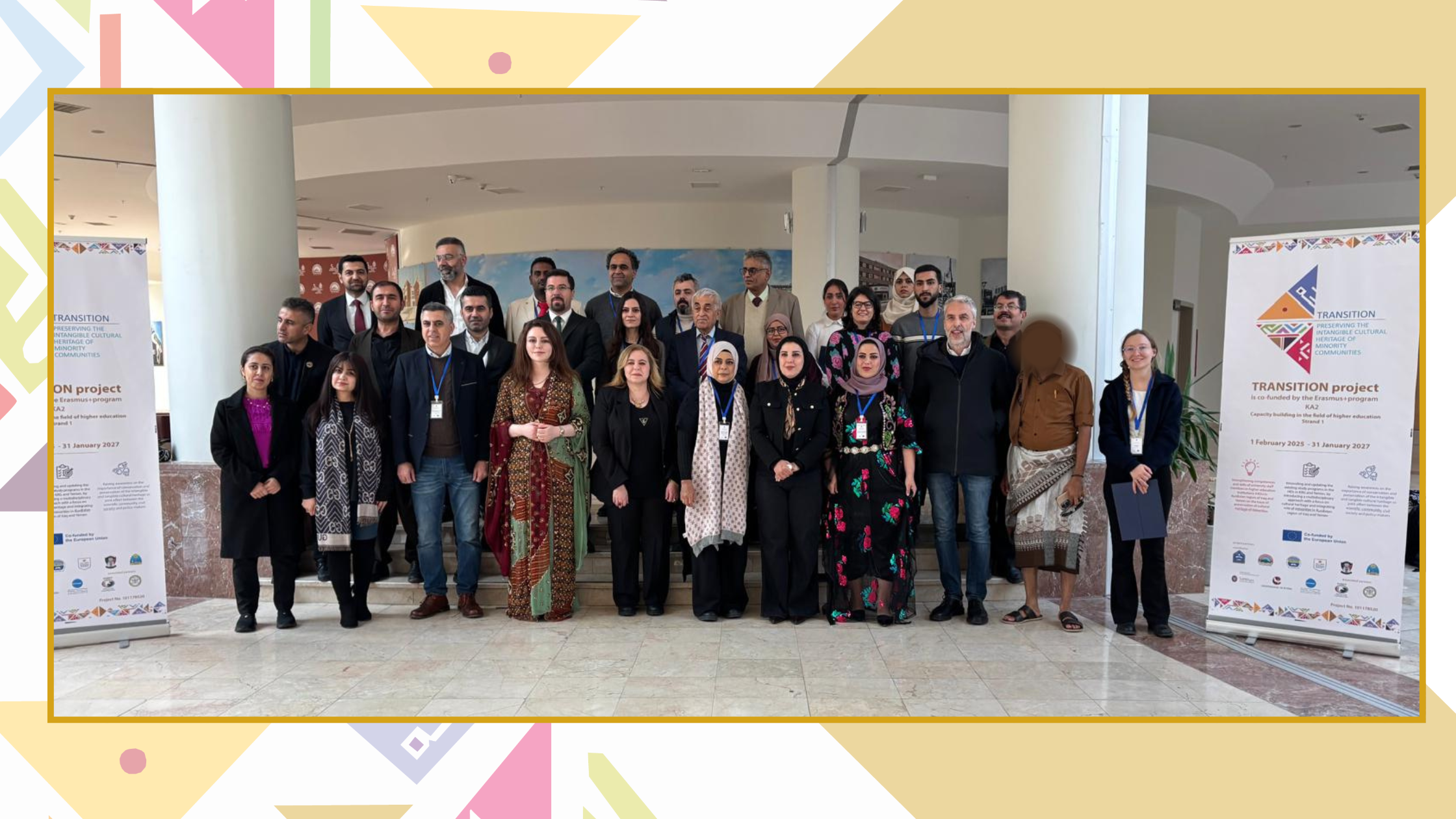
From 8 to 11 December 2025, the University of Sulaimani hosted the TRANSITION WP4 Training Week, an intensive capacity-building activity titled “Empowering Heritage Educators: Cultural Diversity, Minorities, and the SDGs.”
The training gathered almost 35 participants among academic staff and students from partner universities in the Kurdistan Region of Iraq (KRI) – University of Duhok, University of Sulaimani, University of Zakho, Soran University – and Yemen – University of Aden and Taiz University – together with European partners from Italy and Portugal – University of Evora, Sapienza University and UNIMED – to explore how higher education can better recognise, safeguard and promote tangible and intangible cultural heritage, while advancing inclusive teaching and learning approaches aligned with the Sustainable Development Goals (SDGs).
The week opened with a warm welcome from Dr. Karzan Khidhir, Director of International Academic Relations at the University of Sulaimani and from Dr. Sónia Bombico, Researcher at University of Evora, WP4 leader. The European partners presented the training’s objectives and methodology, framing the week as a shared learning space combining academic content, practical tools and field engagement.
Day 1: connecting the SDGs to cultural legacies, digital heritage and linguistic diversity
The first day laid the conceptual and methodological foundations of the Training Week through three complementary sessions delivered by the University of Evora.
The morning session began with an in-person class by Dr. Sónia Bombico focused on how sustainable development frameworks intersect with cultural heritage, using real-world examples and a short practical exercise to help participants translate minority heritage cases into inclusive, sustainability-oriented teaching.
The programme then moved online with Dr. Ana Sofia Ribeiro, who explored how digital humanities and digital tools can support heritage mediation and safeguarding—from documenting and classifying heritage to sharing it with wider audiences.
The day concluded with Dr. Maria Filomena Gonçalves, UNESCO Chair, who examined language as heritage and identity, with particular attention to minority languages, language rights, and multilingualism as a key resource for cultural diversity.
Day 2: voices, identities and minority heritage in practice
Day 2 was dedicated to “voices, identities and heritage,” placing minority perspectives at the centre of the training.
In the morning, Prof. Gianfilippo Terribili and Dr. Ghiath Rammo from Sapienza University guided participants through practical case studies on minorities from the Kurdistan Region of Iraq, the Middle East and the Persian Gulf. The session demonstrated how academic research can be transformed into concrete instruments for public impact—such as exhibitions, documentaries and other cultural initiatives—to support visibility, recognition and inclusion for minority communities.
In the afternoon, the University of Sulaimani with Prof. Kaveh M. Husain, led a fundamental reflection on how and why the term “minority” is used, and Ass. Prof. Dlshad A. Marf explained how heritage spaces—particularly shared shrines—can become living examples of coexistence, interaction and cultural exchange among communities. These exchanges captured the spirit of TRANSITION: connecting universities, researchers and local communities to rethink narratives and promote more inclusive societies.
Day 3: heritage, dialogue and learning through place
Day 3 was fully devoted to heritage, dialogue and field-based learning. The day started with the presentation of the Kurdistan Centre for Arts and Culture, where participants engaged with the Centre’s digital archives and discussed how archiving and digitisation can preserve and share the artistic and cultural memory of the region for new generations.
In the afternoon, visits to the Sulaimani Museum and the Kurdish Heritage Museum offered participants a deeper understanding of the region’s history, identity and traditions. The day concluded in the Sabunkaran neighbourhood, where the group met members of the local Christian community. Their testimonies provided a powerful, real-world perspective on how intercultural and interreligious dialogue is lived in everyday life—and how diversity can become a driver for peaceful coexistence, despite ongoing challenges.
Within this perspective, TRANSITION Training Week was the occasion to equip participants with shared practices and practical tools to value cultural heritage as a driver for dialogue, strengthen social cohesion, and embed intercultural understanding into the daily life of higher education institutions.
Day 4: conclusions, recognition and community encounters
On Day 4, the Training Week concluded with a closing session and certificate award ceremony. Dr. Karzan Khidir thanked participants for their active engagement and acknowledged the contribution of the University of Duhok (project coordinator) as well as the European partners from Italy and Portugal. The participation of Dr. Mohammed Aziz, External Evaluator further reinforced the value and credibility of the week’s outcomes.
The programme ended with a field visit to Hawar Village and Hawraman, where participants met the Yarsan-Kakai’ community and learned more about the cultural heritage of the region—an experience that reinforced the importance of community-based engagement in heritage education and safeguarding.
Strengthening higher education for inclusive heritage
By combining academic sessions, practical case studies, and direct engagement with cultural institutions and communities, the TRANSITION WP4 Training Week in Sulaymaniyah strengthened participants’ capacity to integrate minority-sensitive and SDG-oriented perspectives into teaching, research and outreach. The initiative reaffirmed the role of universities as key actors in promoting heritage as a resource for inclusion, dialogue and sustainable development.
Resources
Day 1
- Connecting SDGs with cultural legacies
- Digital Heritage: mediation, representation, and preservation
- Linguistic heritage as a marker of identity
Day 2
- From scientific research to public engagement: exhibitions on the Yezidi and Yarsan communities in Zagros cultural landscape as a case study
- From field research to international exhibition
- Endangered intangible heritage: the case of Zaar rituals in Qaeshm Island
- Communities in Kurdistan: from differences to minority